
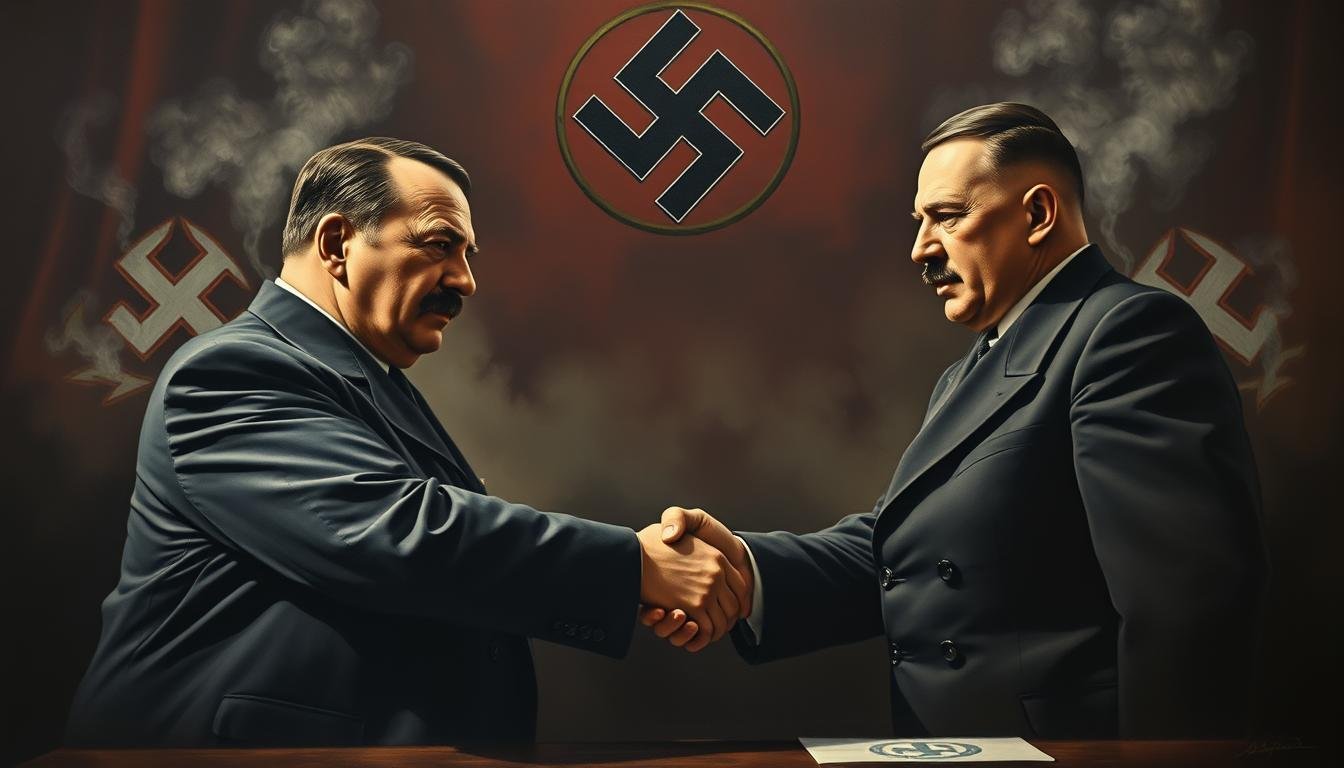
How Stalin Justified His Alliance with Hitler? Many wonder about the alliance between Stalin’s Soviet Union and Hitler’s Nazi Germany. The Molotov-Ribbentrop Pact, signed in 1939, was a pivotal moment in history. It had far-reaching consequences.
The Soviet-Nazi alliance was a strategic move. It allowed both countries to further their interests. As you explore this topic, you’ll gain insight into the historical context.
By examining the justifications provided by Stalin, you’ll understand the complexities of this alliance. You’ll see how it shaped the course of World War II.
Contents
- 1 The Historical Context of the Molotov-Ribbentrop Pact
- 2 How Stalin Justified His Alliance with Hitler to the Soviet People
- 3 Strategic Calculations Behind the Alliance
- 4 From Alliance to Betrayal: The Breakdown of the Pact
- 5 Conclusion: How Stalin Justified His Alliance with Hitler?
- 6 FAQ
- 6.1 What was the Molotov-Ribbentrop Pact?
- 6.2 Why did Stalin form an alliance with Hitler?
- 6.3 How did Stalin justify the Molotov-Ribbentrop Pact to the Soviet people?
- 6.4 What were the consequences of the Molotov-Ribbentrop Pact?
- 6.5 What was the significance of the Molotov-Ribbentrop Pact in history?
- 6.6 What were the strategic benefits of the Molotov-Ribbentrop Pact for the Soviet Union?
The Historical Context of the Molotov-Ribbentrop Pact
The Molotov-Ribbentrop Pact was a key event leading to World War II. It was a non-aggression treaty between the Soviet Union and Nazi Germany. These two powers seemed like opposites.
The Stalled Military Talks
Before World War II, the Soviet Union talked about military alliances with France and the UK. But these talks failed because of mistrust and different goals. The Soviet Union felt the Western powers weren’t serious about fighting Nazi Germany.
Stalin then looked for other options. With Nazi Germany’s threat growing, he chose to ally with Hitler, even if it was temporary. [How Stalin Justified His Alliance with Hitler?]
Western Appeasement of Hitler
The Western powers’ policy of appeasement towards Nazi Germany was also important. The appeasement policy was seen as weak by the Soviet Union. It involved giving in to some of Hitler’s demands to avoid war.
| Event | Date | Impact |
|---|---|---|
| Munich Agreement | September 1938 | Allowed Germany to annex parts of Czechoslovakia, emboldening Hitler [How Stalin Justified His Alliance with Hitler?] |
| Stalled Military Talks | 1939 | Failed to form a strong alliance against Nazi Germany |
| Molotov-Ribbentrop Pact | August 1939 | Soviet Union and Nazi Germany signed a non-aggression treaty |
The Molotov-Ribbentrop Pact was more than just an agreement. It was a strategic move by Stalin to protect the Soviet Union. This pact changed the balance of power in Europe and led to World War II. [How Stalin Justified His Alliance with Hitler?]
How Stalin Justified His Alliance with Hitler to the Soviet People
The Soviet government under Stalin’s leadership called the pact a diplomatic win. You might wonder how they justified this controversial alliance to the people. Stalin’s regime used a clever propaganda campaign to win support for the Molotov-Ribbentrop Pact.
Portraying the Pact as a Diplomatic Victory
Stalin’s government saw the pact as a big win in Soviet foreign policy. The diplomatic victory story was key to convincing the people it was good. By signing, the Soviet Union avoided fighting Nazi Germany right away, which was seen as a big win.
The propaganda machine worked hard to spread this message. Newspapers and radio shows highlighted the pact’s good sides. For example, the Soviet press wrote many articles praising Stalin’s diplomacy skills.
| Propaganda Medium | Message | Impact |
|---|---|---|
| Newspapers | Praise for Stalin’s diplomacy | Boosted public confidence |
| Radio Broadcasts | Emphasis on peace and security | Reduced anxiety about Nazi Germany |
| Posters | Visual representation of Soviet strength | Enhanced national pride |
Shifting Blame to Western Powers
Stalin’s regime also blamed Western powers for the pact. They said Western democracies had failed to create a united defense, forcing the Soviet Union to make the pact with Nazi Germany.
This argument helped avoid criticism and kept public support. By saying the pact was a response to Western diplomacy’s failure, Stalin’s government made the alliance seem justified to the Soviet people.
This complex propaganda effort was key in shaping public opinion during a difficult time in Soviet history. [How Stalin Justified His Alliance with Hitler?]
Strategic Calculations Behind the Alliance
Stalin’s choice to ally with Hitler was a smart move. It aimed to gain from technology sharing and resource swaps. This partnership was more than politics; it was a strategic deal that combined economic and tech cooperation. [How Stalin Justified His Alliance with Hitler?]
German Technology Transfers
The Soviet Union got a big boost from German tech. German know-how in tank design, aircraft making, and chemicals was key for the Soviets. This tech helped the Soviets update their military and industry.
| Technology Area | German Contribution | Soviet Benefit |
|---|---|---|
| Tank Design | Advanced Panzer designs | Modernization of Soviet tank fleet |
| Aircraft Manufacturing | State-of-the-art aircraft models | Enhancement of Soviet air force capabilities |
| Chemical Production | Advanced chemical processes | Improvement in Soviet chemical industry |
Soviet Raw Materials to Germany
The Soviets gave Germany raw materials like grain, oil, and more. This was crucial for Germany’s war and economy. This exchange was a big part of the alliance’s strategy.
- Grain from the Soviet Union fed Germany’s people and soldiers.
- Oil from the Soviet Union powered Germany’s war machines.
- Manganese and chrome from the Soviet Union were vital for Germany’s factories and army.
The alliance between the Soviet Union and Nazi Germany was a complex mix of tech and material swaps. It was driven by smart planning from both sides to get the most benefits. [How Stalin Justified His Alliance with Hitler?]
From Alliance to Betrayal: The Breakdown of the Pact
The fragile alliance between the Soviet Union and Nazi Germany fell apart due to different interests. You might wonder what caused this dramatic change. The Molotov-Ribbentrop Pact’s breakdown was a key moment in World War II. It marked a big change in Stalin’s policies and how he used propaganda.
Germany’s attack on the Soviet Union in June 1941, called Operation Barbarossa, surprised Stalin. The sudden betrayal caused a chaotic start from the Soviet leaders.
Stalin’s Initial Reaction to the Invasion
Stalin was shocked and dismayed by the invasion. For days, he was missing from public sight, leaving others to speak to the nation. When he finally spoke, he showed strength and called on the Soviet people to defend their homeland. [How Stalin Justified His Alliance with Hitler?]
Reverting to Anti-Fascist Rhetoric
As the invasion’s reality hit, Soviet propaganda turned back to its anti-fascist stance. The Nazi regime was again attacked, and the Soviet people were urged to fight against the common enemy. This change in propaganda aimed to gather support against Hitler’s Germany.
The Molotov-Ribbentrop Pact’s breakdown and Stalin’s reaction show the complex nature of Soviet policy in World War II. It shows how a shift from alliance to enemy was managed through strategy and propaganda.
Conclusion: How Stalin Justified His Alliance with Hitler?
Stalin navigated the early 20th century’s complex world. He made key decisions that changed history. The Molotov-Ribbentrop Pact, an unlikely alliance with Nazi Germany, was seen as a way to protect Soviet interests. [How Stalin Justified His Alliance with Hitler?]
Looking back, Stalin’s reasons for the pact were complex. They involved strategic thinking, propaganda, and the real world. Even though it ended in betrayal, it’s a key part of World War II history. It shows how international relations work during crises.
Stalin’s reasons for teaming up with Hitler give us a deeper look at history. It shows the challenges the Soviet leaders faced. Stalin’s choices were influenced by his beliefs, strategy, and practical needs.
See Also: What If Hitler Didn’t Kill Himself? The Alternate History
FAQ
What was the Molotov-Ribbentrop Pact?
The Molotov-Ribbentrop Pact was a treaty between the Soviet Union and Nazi Germany. It was signed on August 23, 1939.
Why did Stalin form an alliance with Hitler?
Stalin wanted to team up with Hitler for several reasons. He hoped for German tech and Soviet raw materials for Germany. He also felt let down by Western powers and their soft stance on Nazi Germany.
How did Stalin justify the Molotov-Ribbentrop Pact to the Soviet people?
Stalin told the Soviet people it was a win. He blamed Western powers and used propaganda to keep support. [How Stalin Justified His Alliance with Hitler?]
What were the consequences of the Molotov-Ribbentrop Pact?
The pact fell apart when Germany attacked the Soviet Union. This led to a big change in Soviet policy. Stalin started speaking out against fascism again.
What was the significance of the Molotov-Ribbentrop Pact in history?
The pact was a key moment in history. It showed a temporary alliance between two big enemies. It also played a big role in starting World War II.
What were the strategic benefits of the Molotov-Ribbentrop Pact for the Soviet Union?
The pact helped the Soviet Union a lot. It brought in German tech and Soviet raw materials. This helped modernize the Soviet economy and military. [How Stalin Justified His Alliance with Hitler?]

Jayceon Schaefer, a social worker from Wailuku, Hawaii, is passionate about history. He created HitlerStory.com to share his deep interest in Adolf Hitler and explore complex historical topics through writing.