
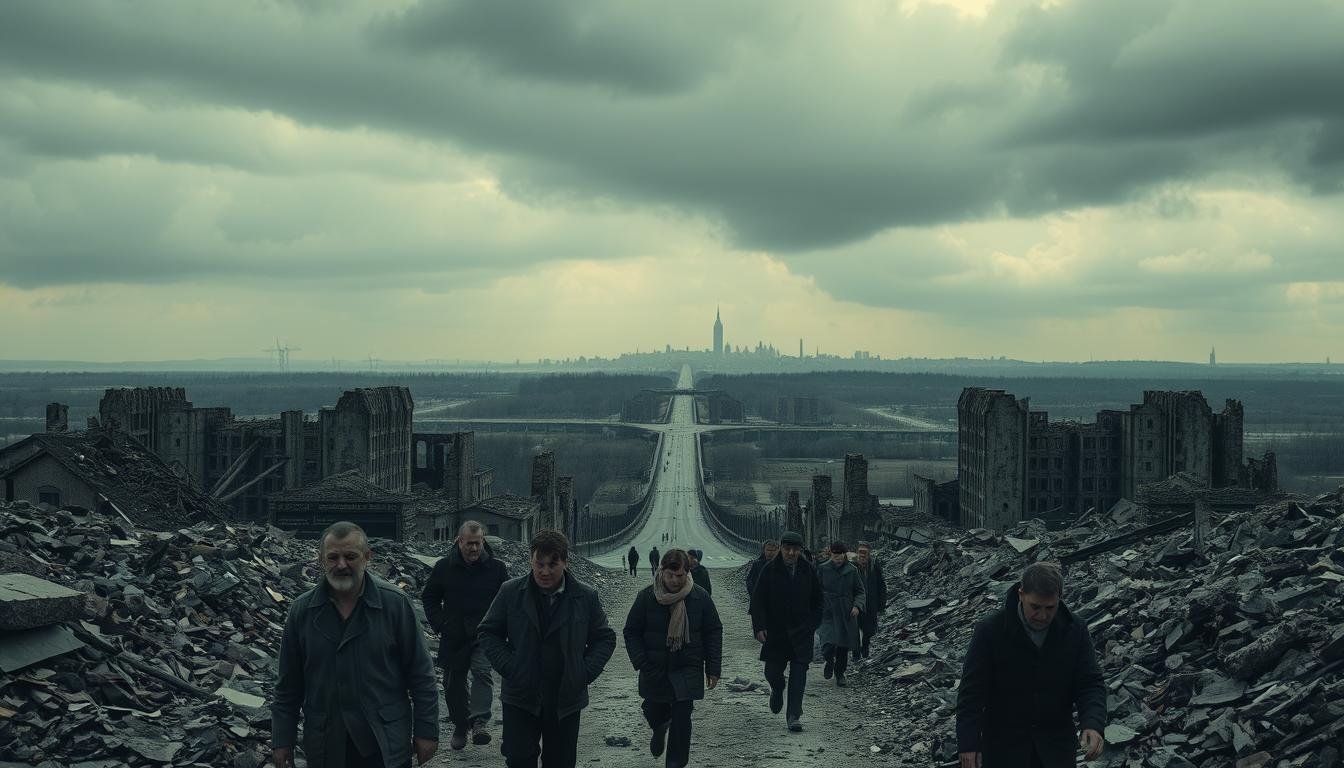
What Happened to Germany After Hitler’s Death? Exploring the time after Hitler’s demise reveals key events that changed Germany’s future. His death started a new chapter for the country.
The effects of Hitler’s death were huge, leading to Germany’s division and recovery. You’ll learn about this crucial time. It shows how Germany moved from Nazi rule to rebirth.
This change was key in forming today’s Germany. By looking at these events, you’ll get a better grasp of Germany after WWII.
Contents
The Final Days of the Third Reich
The end of the Third Reich was filled with chaos and desperation. Nazi Germany was on the brink of defeat. The Allies were closing in from all sides, weakening the Nazi hold on Germany. [What Happened to Germany After Hitler’s Death?]
The military situation was very bad. The Soviet Union was pushing from the East, and the Western Allies were coming from the West. The once-mighty German army was in disarray. The people living in Germany were caught in the middle of the fighting.
The final days included several key events:
- The Soviet Union’s capture of Vienna
- The Western Allies crossing the Rhine
- The encirclement of Berlin
| Date | Event | Significance |
|---|---|---|
| April 12, 1945 | US troops cross the Elbe River | Advancement into central Germany |
| April 20, 1945 | Soviet forces reach Berlin’s outskirts | Encirclement of Berlin begins |
| April 30, 1945 | Hitler’s death | Collapse of the Third Reich accelerates |
As the Third Reich fell, the world saw the end of a dark time. The defeat of Nazi Germany was not just a military loss. It was the end of a harmful ideology that caused great destruction and suffering.
What Happened to Germany After Hitler’s Death: Immediate Aftermath
After Hitler’s death, the Allies took over Germany. They started a period of denazification and rebuilding. The Allies quickly took control of key German cities, ending the Third Reich’s terror.
The Allied occupation aimed to change Germany’s politics, society, and economy. The denazification process was key. It aimed to remove former Nazi Party members from power. [What Happened to Germany After Hitler’s Death?]
Allied Control and Denazification
The United States, Great Britain, and the Soviet Union formed the Allied Control Council (ACC). The ACC oversaw occupied Germany. It focused on denazification, demilitarization, and democratization.
| Allied Power | Zone of Control | Key Actions |
|---|---|---|
| United States | Southern Germany | Denazification, democratization efforts |
| Great Britain | Northwestern Germany | Demilitarization, industrial disarmament |
| Soviet Union | Eastern Germany | Establishment of socialist government, land reform |
The denazification process removed Nazi officials and dissolved the Nazi Party. It also prosecuted war criminals. The table shows the actions of each Allied power in their zones.
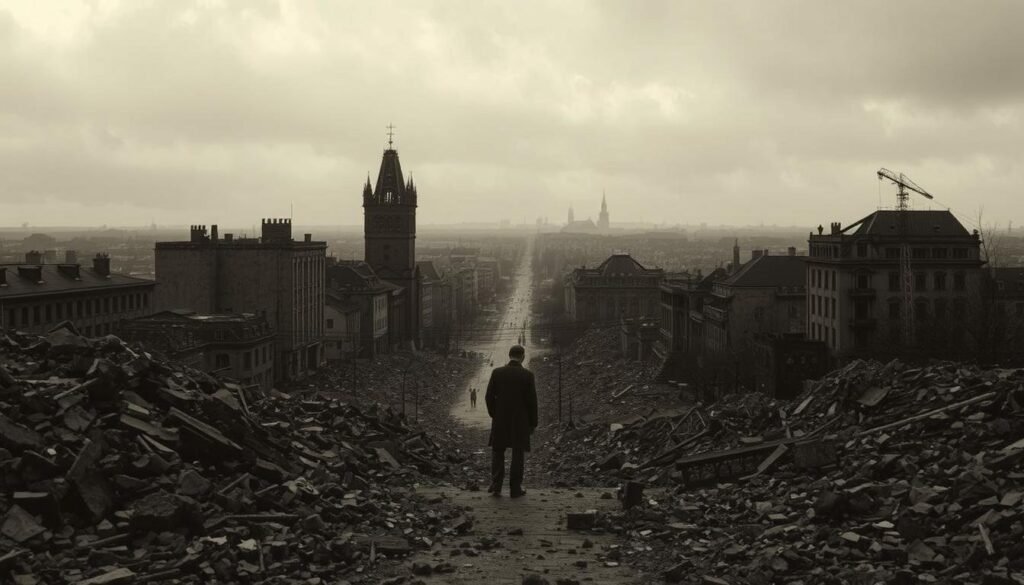
Germany’s rebuilding was tough, with millions of displaced persons and refugees. But, Hitler’s death was a turning point. It started Germany’s path to recovery and rejoining the world. [What Happened to Germany After Hitler’s Death?]
The Division of Germany
Germany’s split into East and West was a key event in history after World War II. It was shaped by the tensions of the time. This division was not simple but complex, influenced by the Allied powers.
The Potsdam Agreement in 1945 was a major step. The United States, Great Britain, and the Soviet Union decided to divide Germany. They controlled four zones: American, British, French, and Soviet.
As the Cold War grew, the differences between the Western Allies and the Soviet Union became clear. The Western zones merged into one economic unit in 1947. The Deutsche Mark in the Western zones made the economic gap wider. This led to the Soviet Union’s Berlin Blockade in 1948-1949.
The division became official with the creation of West Germany in May 1949 and East Germany in October 1949. West Germany joined the Western bloc, while East Germany aligned with the Soviet Union.
This division deeply affected the German people. Families were torn apart, and the country became a Cold War battleground. The split also created big economic and social gaps between East and West Germany.
Understanding Germany’s division is key to understanding post-war Europe. It shows how historical events still shape our world today. [What Happened to Germany After Hitler’s Death?]
Rebuilding and Recovery
Germany was in ruins, but the journey to rebuild started with economic and political focus. You will see how Germany went from devastation to a strong economy and stable politics.
The Wirtschaftswunder, or economic miracle, was key to Germany’s recovery. It was marked by fast economic growth. This was thanks to the Deutsche Mark, the Marshall Plan, and a focus on industrial productivity. You’ll learn how these steps helped the economy bounce back.
Political rebuilding was also vital. A new political setup was formed, dividing Germany into East and West. You’ll meet figures like Konrad Adenauer, the first Chancellor of the FRG.
The rebuilding also brought back democratic institutions and stability. These efforts helped Germany become a major political force in Europe.
Some key strategies included:
- Investment in infrastructure to boost economic growth
- Promoting industrial productivity through new technologies
- Creating a stable currency to boost economic confidence
These actions helped Germany recover amazingly. It became one of Europe’s top economies and a model for rebuilding after conflict. [What Happened to Germany After Hitler’s Death?]
Conclusion: What Happened to Germany After Hitler’s Death?
Germany’s journey after Hitler’s death was complex and tough. The country was divided for decades, leaving a lasting legacy. But in 1990, Germany united, ending the post-war era and starting a unified Europe.
This reunification changed European politics and economy. It made the European Union stronger and boosted economic ties among countries. Yet, the division’s legacy still affects Germany, with ongoing efforts to bridge the gap between East and West.
Today, Germany shows the strength of resilience and determination. Its journey to unity is a lesson in the power of working together. It reminds us that unity and cooperation can overcome big challenges.
FAQ
How did the Allies occupy Germany after Hitler’s death?
The Allies, including the U.S., Great Britain, and the Soviet Union, divided Germany into four zones. Each zone was controlled by a major power. The occupation aimed to remove Nazi influence and establish a new political order.
What was denazification, and how was it implemented?
Denazification aimed to remove former Nazi Party members from power. The Allies used the Nuremberg Trials and dismissed Nazi officials. They also banned Nazi ideology.
Why was Germany divided into East and West Germany?
Germany split into East and West due to post-war reorganization and Cold War tensions. The division was formalized in 1949 with the creation of West Germany and East Germany.
How did Germany recover economically after World War II?
Germany’s economic recovery, known as the “economic miracle,” was driven by several factors. These included the Marshall Plan, a stable currency, and market-oriented policies.
What led to the reunification of Germany in 1990?
Reunification was driven by the decline of Soviet influence, democratic movements in East Germany, and diplomatic efforts. These factors combined to bring Germany back together. [What Happened to Germany After Hitler’s Death?]
Jayceon Schaefer, a social worker from Wailuku, Hawaii, is passionate about history. He created HitlerStory.com to share his deep interest in Adolf Hitler and explore complex historical topics through writing.