
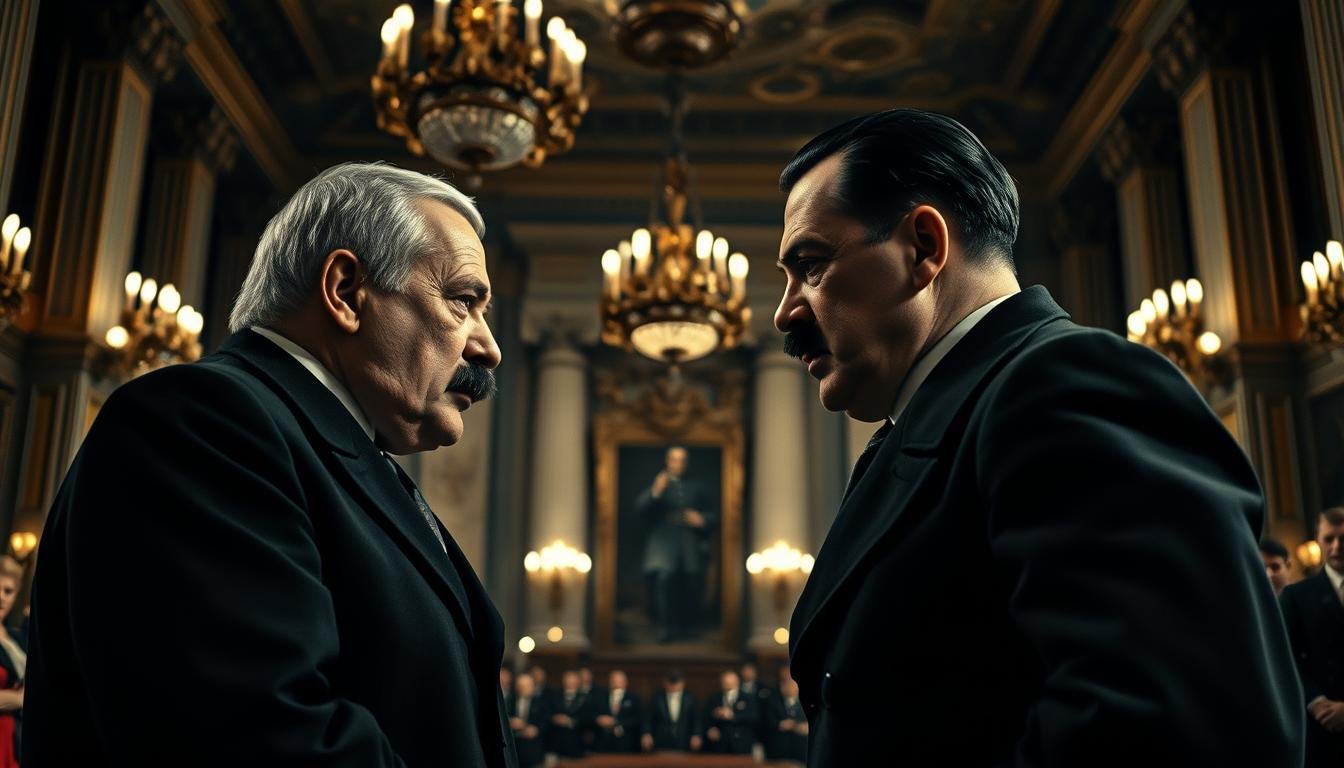
Did Hitler Have More Power Than Hindenburg? You are about to explore a key moment in history. It’s the power struggle between Adolf Hitler and Paul von Hindenburg in the Weimar Republic. This time was marked by political instability and the rise of Nazi Germany.
The Weimar Republic was set up after World War I. It was a fragile democracy that had trouble staying stable. As the economy got worse, politics became more unstable. This created a showdown between Hindenburg, Germany’s president, and Hitler, the leader of the Nazi Party.
Knowing about this power struggle helps us understand how Hitler took control. He changed Germany into Nazi Germany.
Contents
- 1 The Weimar Republic: Setting the Stage
- 2 Paul von Hindenburg: Powers of the President
- 3 Adolf Hitler’s Rise to Power
- 4 Did Hitler Have More Power Than Hindenburg?
- 5 The Enabling Act of1933: A Power Shift
- 6 Hindenburg’s Declining Influence
- 7 After Hindenburg’s Death: Hitler’s Complete Control
- 8 Conclusion: Did Hitler Have More Power Than Hindenburg?
- 9 FAQ
- 9.1 What was the significance of the Weimar Republic in Hitler’s rise to power?
- 9.2 What powers did President Hindenburg hold under the Weimar Constitution?
- 9.3 How did Hitler’s appointment as Chancellor impact his power?
- 9.4 How did Hindenburg’s declining health impact his influence?
- 9.5 How did Hitler consolidate his power after Hindenburg’s death?
- 9.6 What role did propaganda play in Hitler’s rise to power?
The Weimar Republic: Setting the Stage
To understand the power struggle between Hitler and Hindenburg, we must first know about the Weimar Republic. This government was set up in 1919 after World War I.
Economic Challenges and Political Instability
The Weimar Republic faced big economic problems like hyperinflation and high joblessness. These issues led to political instability. Political instability was a big problem, with many coalition governments and elections.
The Birth of the Weimar Constitution
In 1919, the Weimar Constitution was created. It made Germany a federal republic with a president, a chancellor, and a parliament. The constitution set out how the government would work and who had what power.
The Weimar Constitution gave the president a lot of power. He could pick the chancellor and even dissolve the parliament. [Did Hitler Have More Power Than Hindenburg?]
Article 48: Emergency Powers
Article 48 of the Weimar Constitution gave the president special powers. He could suspend civil liberties and make laws by decree in emergencies. This article was key in the fight for power between Hitler and Hindenburg.
| Key Features | Description |
|---|---|
| Economic Challenges | Hyperinflation, high unemployment |
| Political Instability | Numerous coalition governments, frequent elections |
| Division of Powers | President, chancellor, parliament |
| Article 48 | Emergency powers, suspension of civil liberties |
The Weimar Republic’s setup and problems were the backdrop for the power struggle between Hitler and Hindenburg. Knowing these details is key to understanding this important time in German history.
Paul von Hindenburg: Powers of the President
Paul von Hindenburg’s presidency under the Weimar Constitution was complex. He had a lot of power but also faced limits. As the second president of the Weimar Republic, Hindenburg played a big role in shaping Germany’s politics.
Presidential Powers Under the Weimar Constitution
The Weimar Constitution gave the president a lot of power. He could pick and fire the chancellor, dissolve the Reichstag, and make emergency decrees under Article 48. This made the president very important in German politics.
Hindenburg’s Use of Emergency Decrees
Hindenburg often used emergency decrees to get things done without the Reichstag. This helped him deal with crises fast but hurt the Reichstag’s power.
Hindenburg’s military past and status as a national hero greatly influenced how people saw him. His leadership in World War I and the Battle of Tannenberg made him very respected. He used this respect to keep public support.
Relationships with Political Parties
Hindenburg’s relationships with political parties were complicated. He started off well with conservatives and nationalists but his use of emergency decrees and picking chancellors upset liberals and socialists.
| Aspect | Description | Impact |
|---|---|---|
| Presidential Powers | Appointment of chancellor, dissolution of Reichstag, emergency decrees | Dominant figure in German politics |
| Emergency Decrees | Bypassed Reichstag, direct policy implementation | Erosion of parliamentary authority |
| Military Background | National hero, leadership in WWI | Widespread public respect and support |
Adolf Hitler’s Rise to Power
The early 1930s were key for Hitler. He used his electoral wins to gain power. His Nazi Party saw big gains, helping him rise.
Electoral Gains and Public Support
Hitler’s party grew fast, becoming the second-biggest in the Reichstag by 1930. His charm and Germany’s economic woes helped his popularity soar.
Propaganda and Intimidation Tactics
Hitler used propaganda and intimidation to win people over. He blamed the Weimar Republic for Germany’s issues. His groups, like the SA, scared off his opponents.
In 1933, Hitler became Chancellor, a big step for him. President Hindenburg’s support and Hitler’s growing fame helped him get there. [Did Hitler Have More Power Than Hindenburg?]
Initial Limitations on Hitler’s Authority
At first, Hitler had to share power with other politicians. But he soon took control, becoming the top figure in Germany.
Did Hitler Have More Power Than Hindenburg?
As we dive into the power struggles of the Weimar Republic, a big question comes up: Did Hitler have more power than Hindenburg? We must look at Hindenburg’s role as President and Hitler’s role as Chancellor. We also need to see how their political moves affected their power.
Hindenburg’s Legal Authority as President
Hindenburg, the President of the Weimar Republic, had a lot of legal power. He could pick and fire the Chancellor and make emergency rules under Article 48 of the Weimar Constitution. This gave him a big say in the government. [Did Hitler Have More Power Than Hindenburg?]
Hitler’s Initial Position as Chancellor
Hitler, when he became Chancellor in 1933, seemed like he was under Hindenburg. But he quickly started to build his power base, changing the political scene.
Hitler’s clever moves were key to his rise. He used the Reichstag fire to get the Enabling Act. This law let him make rules without the Reichstag’s okay, weakening Hindenburg’s power.
Hindenburg’s Declining Control
As Hitler got stronger, Hindenburg’s power went down. The Enabling Act and other laws took away Hindenburg’s say in policy. He became more of a symbol than a real leader.
| Aspect | Hindenburg’s Power | Hitler’s Power |
|---|---|---|
| Initial Position | President with significant legal authority | Chancellor with limited initial power |
| Legal Authority | Could appoint/dismiss Chancellor, issue emergency decrees | Gradually gained legislative power through Enabling Act |
| Political Maneuvering | Limited by constitutional constraints | Used events like the Reichstag fire to consolidate power |
In conclusion, Hindenburg started with a lot of power as President. But Hitler’s smart moves and growing power eventually made him more influential. Understanding these power shifts helps us see the complex politics of the Weimar Republic.
The Enabling Act of1933: A Power Shift
Learn how the Enabling Act of 1933 helped Hitler gain total power. This law was a key moment in German history. It moved power from the Weimar Republic to the Nazi regime.
Emergency Decrees Following the Fire
After the Reichstag fire in February 1933, Hitler convinced President Hindenburg to make emergency decrees. These decrees, based on Article 48 of the Weimar Constitution, let the government ignore some civil rights. This move effectively silenced opposition.
Suppression of Political Opposition
The emergency decrees were used to arrest and scare political foes, especially communists and social democrats. This made a climate of fear. It helped Hitler to gather more power. [Did Hitler Have More Power Than Hindenburg?]
On March 23, 1933, the Enabling Act was passed. It gave Hitler and his cabinet the power to make laws without the Reichstag’s help. This made Hitler the real dictator of Germany.
Constitutional Implications
The Enabling Act had big constitutional effects. It let the government ignore the constitution when making laws. This weakened the Weimar Republic’s laws and led to the Nazi regime’s total control.
Hindenburg’s Declining Influence
Hitler saw a chance to gain more power as Hindenburg’s health got worse. The president’s ability to make good decisions was greatly reduced.
Hindenburg’s Physical Decline
Hindenburg’s health started to fall apart, making it hard for him to do his job. His physical decline also affected his mind.
Impact on Decision-Making Capacity
Hindenburg’s health issues made it hard for him to make smart choices. Hitler and his team filled this power gap.
Hitler took advantage of Hindenburg’s weakness by removing his allies. This move made Hitler’s control stronger and Hindenburg’s weaker.
Hitler’s Control of Government Communications
Hitler got control over how the government talked to people. He spread his ideas and policies easily. This helped him shape public opinion and reduce Hindenburg’s influence. [Did Hitler Have More Power Than Hindenburg?]
As Hindenburg’s power went down, Hitler’s grip on power got tighter. This set the stage for what would happen after Hindenburg’s death.
After Hindenburg’s Death: Hitler’s Complete Control
The death of Hindenburg in August 1934 was a turning point. It allowed Hitler to take full control. With the President’s office empty, Hitler merged the President and Chancellor roles. This gave him total power over Germany.
The Law Concerning the Head of State
Hitler created the “Law Concerning the Head of State of the German Reich.” It abolished the President’s office and combined its powers with the Chancellor’s. Since Hitler was the Chancellor, he became the supreme leader of Germany.
The German military had to swear loyalty to Hitler. This oath was personal, not to the Weimar Constitution or the state. It made sure the military followed Hitler’s orders.
Dismantling of Remaining Checks and Balances
Hitler worked to remove any limits on his power. He shut down opposition parties and took over the judiciary. He made sure all government bodies followed his beliefs. [Did Hitler Have More Power Than Hindenburg?]
The Transformation of Germany into a Totalitarian State
Germany became a totalitarian state under Hitler. He controlled the military and eliminated opposition. This allowed him to carry out his plans without any opposition. It marked the end of the Weimar Republic and the start of the Nazi dictatorship.
| Event | Date | Impact |
|---|---|---|
| Hindenburg’s Death | August 1934 | Hitler consolidates power |
| Law Concerning the Head of State | August 1934 | Merge of President and Chancellor roles |
| Military Oath | August 1934 | Military allegiance to Hitler personally |
Conclusion: Did Hitler Have More Power Than Hindenburg?
You’ve learned about the power battle between Hitler and Hindenburg in Nazi Germany. This battle led to a total control regime. Hitler’s drive and smart moves were key in beating Hindenburg’s power.
The Enabling Act of 1933 was a big change. It let Hitler grow his power. As Hindenburg’s influence went down, Hitler’s grip on Germany got stronger. This set the stage for his full control after Hindenburg’s death.
This story shows us how the Nazi regime grew and the risks of too much power. Hitler’s clever and strategic steps led to his total control. This resulted in one of history’s most infamous total control regimes.
See Also: What Did Hitler Think of the Irish?
FAQ
What was the significance of the Weimar Republic in Hitler’s rise to power?
The Weimar Republic faced economic troubles and political instability. Its constitution also played a big role. These factors helped Hitler gain power.
What powers did President Hindenburg hold under the Weimar Constitution?
Hindenburg had a lot of power. He could issue emergency decrees under Article 48. This gave him a lot of authority during crises. [Did Hitler Have More Power Than Hindenburg?]
How did Hitler’s appointment as Chancellor impact his power?
Hitler became Chancellor, starting his rise to power. But, his power was still limited by Hindenburg and others at first.
How did Hindenburg’s declining health impact his influence?
Hindenburg’s health problems made his decision-making weaker. Hitler used this to gain more power.
How did Hitler consolidate his power after Hindenburg’s death?
Hitler made the military swear an oath to him. He also removed checks and balances. This turned Germany into a totalitarian state under his rule.
What role did propaganda play in Hitler’s rise to power?
Propaganda was key for Hitler. It helped him spread his ideology, attack his enemies, and build a personal cult. This helped him gain and keep power. [Did Hitler Have More Power Than Hindenburg?]

Jayceon Schaefer, a social worker from Wailuku, Hawaii, is passionate about history. He created HitlerStory.com to share his deep interest in Adolf Hitler and explore complex historical topics through writing.